Our Environmental Commitment
Sustainability Is Not a Feature. It Is Our Foundation.
Every pallet we recycle is a tree that stays rooted. Every repair we make is waste that never reaches a landfill. At Albuquerque Pallets, environmental responsibility is not an add-on — it is the core of everything we do.
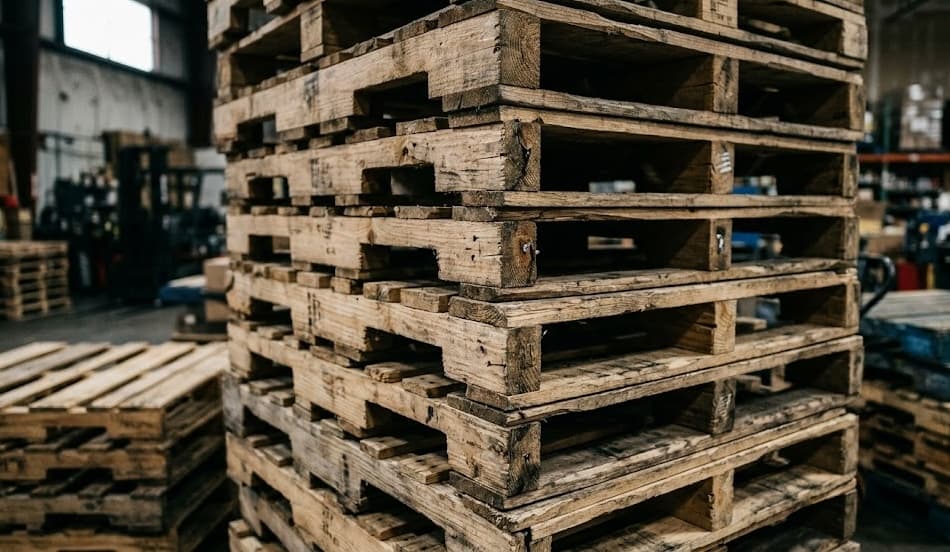
Pallets Given a Second Life
Every stack represents hundreds of trees left standing and tons of waste diverted from landfills
Our Philosophy
Why the Pallet Industry Must Change
The wooden pallet is the unsung backbone of global commerce. There are an estimated 2 billion pallets in circulation in the United States at any given time, moving nearly every product that reaches a store shelf, warehouse, or front door. Yet the industry that produces and manages these critical shipping platforms has historically operated on a linear model: harvest trees, build pallets, use them a few times, then discard them.
The environmental toll of this approach is enormous. Approximately 3.5 billion board feet of hardwood and softwood lumber go into pallet production each year in the U.S. alone — roughly 40% of all hardwood lumber produced nationally. When those pallets reach end-of-life prematurely, they consume landfill space, release methane as they decompose, and represent an enormous waste of the energy and resources used to grow, harvest, and process that lumber.
We believe a different model is not only possible but essential. By extending the life of every pallet through rigorous repair, by recycling every board that cannot be reused as-is, and by converting even the smallest scraps into useful byproducts, we can dramatically reduce the demand for virgin lumber, shrink the industry's carbon footprint, and prove that sustainability and profitability go hand in hand.
The Problem in Numbers
!
420 Million Pallets Landfilled Annually
In the U.S., nearly half a billion pallets end up in landfills every year despite being repairable or recyclable.
!
40% of U.S. Hardwood Goes to Pallets
The pallet industry is one of the largest consumers of hardwood lumber. Reducing waste here has outsized environmental impact.
!
Methane from Decomposing Wood
Wood in landfills decomposes anaerobically, producing methane — a greenhouse gas 80x more potent than CO2 over 20 years.
The Solution Exists
Up to 95% of discarded pallets can be repaired, recycled, or repurposed. The infrastructure simply needs to be built. That is what we do.
Measurable Results
Our Environmental Impact
We do not just talk about sustainability — we track it. Here are the real numbers behind our environmental commitment, updated as our operations grow.
125,000+
Pallets Recycled
Each recycled pallet saves approximately 3.5 board feet of new lumber from being harvested.
8,400+
Trees Conserved
A single mature tree yields roughly 15 standard pallets. Our recycling work has spared thousands of trees.
3,200+
Tons of CO2 Prevented
Manufacturing new pallets produces approximately 25 kg of CO2 each. Reusing pallets eliminates that entirely.
4,600+
Tons Diverted from Landfill
A standard 48x40 pallet weighs about 35 pounds. Every pallet we save is 35 pounds less in a landfill.
95%
Waste Diversion Rate
Of all pallets we receive, 95% are repaired, resold, or recycled into usable material. Almost nothing goes to waste.
70%
Energy Savings vs. New
Repairing and reusing pallets requires roughly 70% less energy than manufacturing new ones from raw lumber.
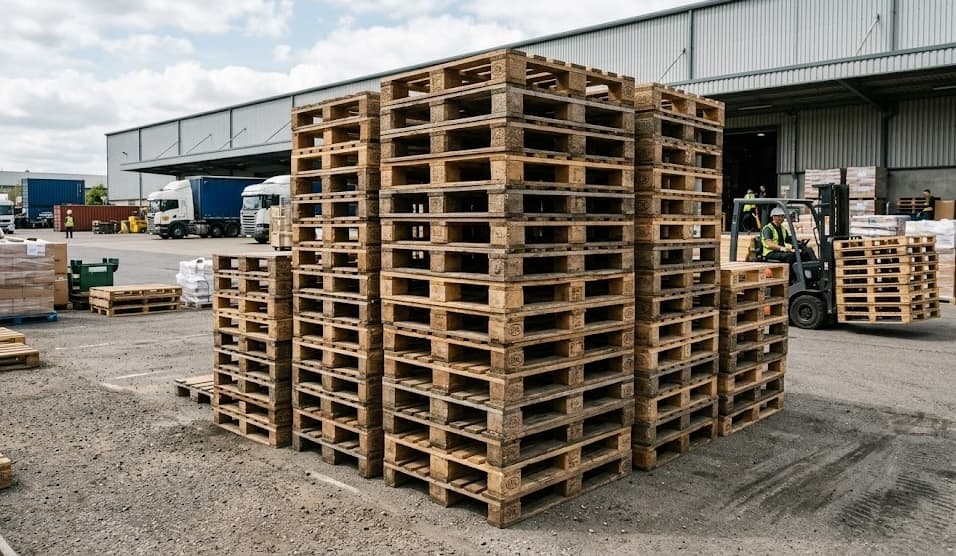
By the Numbers
Deep Dive into Our Environmental Data
We believe transparency builds trust. Here is a closer look at how our recycling operations translate into tangible environmental benefits, backed by industry-standard calculations and comparisons with national averages.
The U.S. pallet industry recycled approximately 508 million pallets in 2022, according to Virginia Tech's Center for Packaging and Unit Load Design. However, the national recycling rate still hovers around 65-70%, meaning nearly a third of all wooden pallets still end up in landfills. Our 95% waste diversion rate significantly exceeds the national average.
Environmental Impact Breakdown
Detailed calculations showing how our pallet recycling operation compares with industry averages and contributes to New Mexico's environmental health.
Carbon Calculations
Manufacturing a new 48x40 GMA pallet from raw lumber produces approximately 28.5 kg of CO2 equivalent emissions when accounting for the full lifecycle: forestry operations (3.2 kg), log transportation to the sawmill (2.1 kg), sawing and kiln drying (12.8 kg), transport to pallet manufacturer (1.9 kg), and pallet assembly (8.5 kg).
Repairing an existing pallet generates approximately 3.8 kg of CO2 equivalent — a reduction of 87% compared to manufacturing new. This includes replacement board sourcing (1.2 kg), repair labor energy (0.9 kg), and quality inspection (1.7 kg).
Across our 125,000+ processed pallets, the cumulative carbon savings amount to over 3,200 metric tons of CO2 equivalent. That is comparable to removing 694 passenger vehicles from the road for one full year, or the carbon sequestered by 3,900 acres of U.S. forest annually.
Water Savings
Growing the timber for a single new pallet requires an estimated 264 gallons of water when factoring in the full tree growth cycle and milling process. Sawmill operations add another 12-15 gallons per pallet for blade cooling, dust suppression, and kiln drying steam.
Our repair and recycling operations use zero process water. We do not wash or chemically treat pallets. All cleaning is done through dry methods — hand brushing, air blasting, and mechanical scraping. In a state like New Mexico where water is precious and drought conditions are increasingly common, this zero-water approach is especially meaningful.
Over the lifetime of our operations, we estimate that our pallet recycling has conserved approximately 33 million gallons of water that would have been needed to grow and process replacement timber. That is enough water to supply over 300 Albuquerque households for an entire year.
Landfill Diversion Statistics
A standard 48x40 GMA pallet weighs between 33 and 48 pounds depending on wood species and moisture content, with an average of approximately 37 pounds. At our processing volume, we divert approximately 4,600 tons of wood waste from landfills annually.
In the Albuquerque metro area, wood waste accounts for roughly 12% of total landfill volume. Our operations reduce that contribution meaningfully. For comparison, the Cerro Colorado Landfill (Albuquerque's primary municipal landfill) receives approximately 1.2 million tons of waste per year. Our 4,600 tons represent a small but real reduction in the pressure on that facility.
When wood decomposes in a landfill, it produces methane under anaerobic conditions. Methane is 80 times more potent as a greenhouse gas than CO2 over a 20-year period. By diverting 4,600 tons of wood from landfills, we prevent the generation of an estimated 690 tons of methane over the next two decades.
New Mexico Tree Species Conserved
While the pallets we recycle were originally manufactured from lumber sourced across the country, every pallet we save from the landfill reduces demand for new timber harvesting. Tree species commonly used in pallet manufacturing that are native or grown in the greater Southwest region include:
- - Ponderosa Pine (Pinus ponderosa) — New Mexico's most commercially harvested softwood
- - Douglas Fir (Pseudotsuga menziesii) — common in Northern NM mountain forests
- - White Fir (Abies concolor) — found in the Sangre de Cristo and Jemez Mountains
- - Cottonwood (Populus deltoides) — grows along the Rio Grande bosque
- - Southern Yellow Pine — the most common pallet lumber sourced from the Southeast U.S.
New Mexico's forests are particularly stressed by drought, bark beetle infestations, and increasing wildfire frequency. Every tree conserved through recycling helps maintain forest health, watershed protection, and wildlife habitat in the Land of Enchantment.
How We Compare
Our Performance vs. Industry Averages
| Metric | Albuquerque Pallets | Industry Average |
|---|---|---|
| Waste Diversion Rate | 95% | 65-70% |
| Water Usage per Pallet | 0 gallons (dry process) | 2-5 gallons |
| CO2 per Recycled Pallet | 3.8 kg | 6-9 kg |
| Pallet Lifecycle Extension | 3-5x original cycles | 1-2x |
| Material Reclamation from Unusable Pallets | 98% of wood mass | 60-75% |
| Transport Emissions Optimization | GPS-optimized routes, batch delivery | Standard routing |
| Metal Recycling Rate (nails, hardware) | 100% | 40-60% |
Partnerships
Working Together for a Greener Future
Sustainability is a team effort. We partner with organizations across New Mexico and the pallet industry to amplify our environmental impact.
Local Landscaping Companies
We supply wood chips and mulch from dismantled pallets to landscaping companies across the Albuquerque metro. This turns waste into a valuable ground cover product that conserves soil moisture — especially important in our arid climate.
New Mexico Recycling Coalition
We work with the NMRC to promote wood waste recycling awareness and contribute data to statewide diversion tracking. Our goal is to help establish standardized pallet recycling infrastructure across the state.
Community Gardens & Urban Farms
We donate wood chips for mulching and compost at community gardens in the South Valley, International District, and Near Heights neighborhoods. Several community gardens also use our pallets for raised bed construction.
Local Manufacturing Partners
We work with furniture makers, sign builders, and artisan woodworkers who use reclaimed pallet lumber for their projects. This gives high-character wood a creative second life while supporting Albuquerque's maker economy.
Biomass Energy Producers
Wood waste that cannot be repurposed as lumber, mulch, or animal bedding is sent to regional biomass energy facilities. This converts our final waste stream into renewable energy rather than landfill mass.
Agricultural Operations
Farms and ranches across central New Mexico use our wood chips for animal bedding and ground cover in corrals and livestock areas. This provides a cost-effective alternative to commercially produced bedding products.
Circular Economy
How We Close the Loop
The circular economy model replaces the traditional take-make-dispose approach with a closed system where materials stay in productive use for as long as possible. Here is exactly how our process works, step by step.
01
Collection & Pickup
We collect surplus, damaged, and end-of-cycle pallets from businesses across New Mexico. Free pickup service means there is zero cost or hassle for our partners. Pallets that might otherwise be discarded enter our system instead.
02
Inspection & Sorting
Every pallet is individually inspected by our trained team. We assess structural integrity, check for contamination, and sort by condition into Grade A, B, or C categories. Pallets beyond repair are flagged for material reclamation.
03
Repair & Refurbishment
Damaged pallets that are structurally viable are repaired using replacement boards and hardware. Our repair process extends the lifespan of a pallet by 3 to 5 times its original cycle, multiplying the value of the wood already harvested.
04
Resale & Redistribution
Repaired and quality-verified pallets are sold to businesses at significant savings over new. This closes the loop — pallets return to productive use in warehouses, shipping operations, and storage facilities throughout the state.
05
Material Reclamation
Pallets that cannot be repaired are dismantled. Usable boards are salvaged for repair stock or sold as reclaimed lumber. Remaining wood is chipped for mulch, animal bedding, or biomass fuel — ensuring virtually nothing is wasted.
The result? A system where virtually every piece of wood that enters our facility finds productive use.
No waste stream. No unnecessary harvesting. No pallets rotting in landfills. Just efficient, responsible resource management.
Our Commitment
Zero Waste. Zero Compromise.
Our operational target is zero waste — meaning every pallet and every piece of wood that enters our facility is either repaired and resold, recycled into another product, or converted into a useful byproduct. We currently operate at a 95% waste diversion rate, and we are systematically working to close that remaining 5% gap.
Zero waste is not aspirational marketing language for us. It is an engineering challenge we are actively solving. We track material flow through our facility at every stage, identify the points where waste still occurs, and develop processes to eliminate them. The small percentage of material we cannot currently reuse consists primarily of contaminated wood (paint, chemical spills) that cannot safely enter the mulch or fuel stream.
We are researching partnerships with specialized recyclers who can handle contaminated wood safely, and we are working with our pickup partners to identify and separate contaminated pallets earlier in the process. Our goal is to reach 99% diversion within the next two years and true zero waste within five.
Current Diversion Rate95%
2-Year Target99%
5-Year Goal100%
What Happens to the 5%?
The remaining waste consists of chemically contaminated wood, heavily degraded material, and metal fasteners too corroded for standard scrap recycling. We are actively developing solutions for each category.
Climate Action
Carbon Reduction & Tree Conservation
Carbon Footprint Reduction
Manufacturing a new wooden pallet produces approximately 25 kilograms of CO2 equivalent emissions — from harvesting and transporting raw lumber, to kiln drying, sawing, and assembly. When that pallet is discarded after just a few uses and a new one takes its place, those emissions multiply across every cycle.
By repairing and recirculating pallets, we eliminate the need for new manufacturing. Each pallet that completes an additional cycle through repair rather than replacement saves its full 25 kg CO2 manufacturing footprint. Across the 125,000+ pallets we have processed, that amounts to over 3,200 tons of CO2 prevented — equivalent to taking roughly 700 cars off the road for an entire year.
We also reduce transport-related emissions by sourcing pallets locally rather than importing new ones from distant mills. A recycled pallet from Albuquerque has a far smaller transport footprint than a new pallet shipped from Oregon or the Southeast.
Tree Conservation
A single mature hardwood tree yields roughly 15 standard 48x40 pallets. With the U.S. pallet industry consuming an estimated 4.5 to 5 billion board feet of lumber annually, the strain on forests is substantial. The Southwestern U.S. is particularly vulnerable, as our forests already face pressure from drought, wildfire, and bark beetle infestations.
Every pallet we recycle or repair is one fewer pallet that needs to be cut from a tree. Our operations have conserved the equivalent of over 8,400 trees to date. To put that in perspective, that is roughly 50 acres of forestland left standing — absorbing CO2, providing wildlife habitat, preventing soil erosion, and protecting watersheds.
In a state like New Mexico, where forests and water resources are under increasing pressure from climate change, every tree conserved matters. Our work is a small but meaningful contribution to keeping New Mexico's natural landscapes intact for future generations.
Day-to-Day
Green Practices in Our Operations
Sustainability is not just about the pallets themselves. We apply environmental thinking to every aspect of how we run our business, from how we route our trucks to how we manage our paperwork.
Route-Optimized Transport
Our delivery fleet uses GPS-optimized routing to minimize fuel consumption and emissions. We batch pickups and deliveries by geographic zone, reducing empty miles and carbon output per pallet moved.
Water-Free Operations
Unlike some pallet processors, we do not use chemical wash or water treatment processes. Our cleaning and preparation methods are dry, eliminating water waste and chemical runoff entirely.
Sustainable Sourcing
When we do manufacture new pallets, we source lumber from sustainably managed forests. We prioritize suppliers who practice responsible forestry and hold relevant certifications.
Waste-to-Resource Conversion
Wood chips from demolished pallets become mulch for landscaping, bedding for agricultural operations, or fuel for biomass energy. Nails and hardware are collected and recycled as scrap metal.
Energy-Efficient Facility
Our operations facility uses LED lighting, natural ventilation where possible, and energy-efficient equipment. We continually audit our energy usage and invest in improvements that reduce our operational carbon footprint.
Paperless Administration
Our invoicing, order management, and customer communication are fully digital. By eliminating paper-based processes, we reduce our administrative waste footprint to near zero.
Progress Tracking
Year-Over-Year Environmental Progress
We track and publish our environmental performance annually. Here is how our impact has grown as our operation has scaled.
| Year | Pallets Processed | Diversion Rate | CO2 Prevented | Trees Conserved | Landfill Diverted |
|---|---|---|---|---|---|
| 2021 | 85,000 | 89% | 1,800 tons | 2,100 | 1,550 tons |
| 2022 | 110,000 | 91% | 2,400 tons | 2,750 | 2,035 tons |
| 2023 | 140,000 | 93% | 2,900 tons | 3,500 | 2,590 tons |
| 2024 | 165,000 | 94% | 3,100 tons | 4,125 | 3,050 tons |
| 2025 | 180,000+ | 95% | 3,200+ tons | 4,500+ | 3,330+ tons |
2025 figures are projections based on year-to-date performance. Final audited numbers published Q1 of the following year.
Standards & Compliance
Sustainability Certifications & Standards
ISPM-15 Certified Facility
Our heat treatment facility is certified to process wood packaging materials in compliance with ISPM-15 international standards. Regular audits by authorized inspection agencies verify our treatment protocols, temperature logs, and IPPC marking procedures.
NWPCA Member Standards
We adhere to National Wooden Pallet and Container Association quality and environmental guidelines. NWPCA membership ensures our grading, manufacturing, and recycling practices meet industry-recognized benchmarks.
EPA Waste Diversion Methodology
Our environmental impact calculations follow EPA-approved methodologies for waste diversion, CO2 offset, and resource conservation metrics. This ensures our reporting is credible, auditable, and comparable to industry benchmarks.
New Mexico Environment Dept. Compliance
We maintain all required state permits for wood waste processing and recycling operations. Our facility passes annual environmental inspections and operates in full compliance with NMED regulations.
ESG Reporting Framework Compatible
Our environmental data is structured for integration with GRI, SASB, and CDP reporting frameworks. Clients using these standards for investor disclosures can pull our data directly into their ESG reports.
SFI/FSC Chain of Custody Support
For new pallet manufacturing, we source lumber from suppliers participating in Sustainable Forestry Initiative (SFI) or Forest Stewardship Council (FSC) certified supply chains when requested.
Looking Ahead
Sustainability Roadmap
Our environmental commitments extend well into the future. Here are the milestones we are working toward and the timeline for achieving them.
2026
Reach 97% Waste Diversion Rate
Close the gap by partnering with specialized recyclers for contaminated wood and developing in-house treatment for painted pallets. Invest in improved sorting technology to capture more reusable material from the recycling stream.
2027
Fleet Electrification Phase 1
Replace 30% of our local delivery fleet with electric vehicles for Core Zone deliveries. Install on-site EV charging infrastructure powered by rooftop solar panels. Target: 25% reduction in fleet carbon emissions.
2028
99% Waste Diversion + Solar Power
Reach 99% waste diversion by eliminating the last contaminated wood waste streams. Complete installation of a 50kW solar array to power facility operations, reducing grid electricity dependence by 60%.
2029
Carbon Neutral Operations
Achieve carbon-neutral status for all facility operations through a combination of fleet electrification, solar power, and verified carbon offsets for remaining emissions. Third-party audit and certification of net-zero claim.
2030
True Zero Waste + Community Impact Fund
Reach 100% waste diversion with zero material to landfill. Launch the Albuquerque Pallets Community Environmental Fund, dedicating 2% of annual revenue to local conservation, reforestation, and green workforce development programs.
Be Part of the Solution
Every business that chooses recycled pallets over new ones contributes to a healthier planet. Explore how you can reduce your environmental footprint while saving money on your pallet needs.