All Products
New Wood Pallets in Albuquerque
When your application calls for consistent dimensions and a clean appearance, a new pallet may be the right choice. Send your size and quantity, and we will quote it. We sell pallets in standard and custom sizes. Pricing is by quote.
ISPM 15 OptionsStandard SizesCustom SizesPriced by Quote
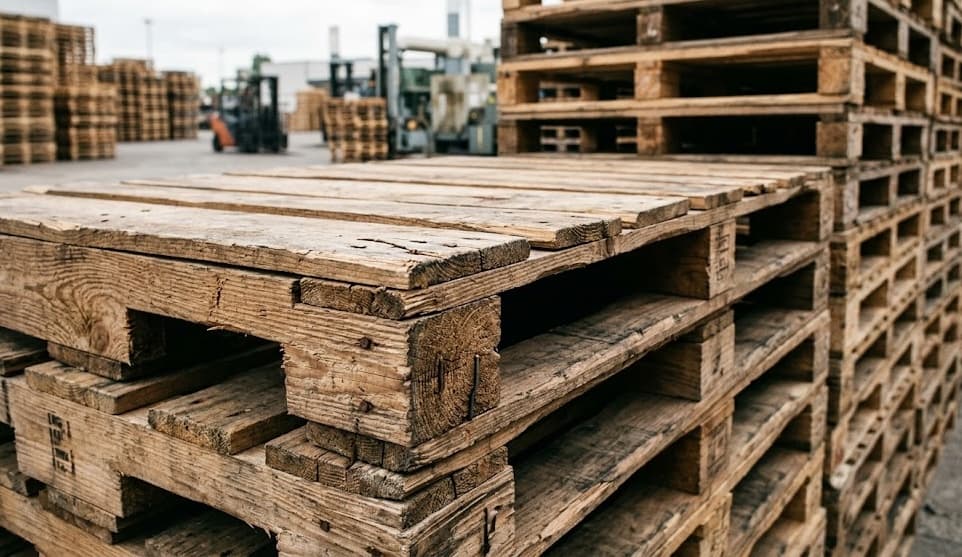
New Wood Pallets by Request
Lumber type and construction depend on the order. Confirm what matters for your load.
New Pallet Options
Choose from standard builds, heat-treated export pallets, or custom configurations. What we offer depends on your load.
Standard New Pallets
The common North American footprint is the GMA 48" x 40". New pallets offer consistent dimensions and a clean appearance for retail and display-sensitive loads. Lumber and construction depend on the order.
Key Features
- GMA 48" x 40" dimensions
- Hardwood or softwood lumber
- Ask us for the load rating
- Uniform, clean appearance
- Forklift and pallet-jack compatible
Heat-Treated (HT) Pallets
ISPM 15 calls for a core temperature of 56 °C for 30 minutes. Many countries apply it to wood packaging to limit the spread of pests. Heat-treated, ISPM 15-marked pallets can be quoted where available.
Key Features
- Marked to show treatment
- Commonly needed for export
- Check current rules for your destination
- Heat, not chemicals, treats the wood
- Ask for any paperwork you need
Custom-Size New Pallets
Need a non-standard footprint? Share your dimensions and we quote building them, from oversized pallets for machinery to compact pallets for narrow racking.
Key Features
- Length, width, and height you specify
- Two-way or four-way entry
- Block or stringer construction
- Choice of board spacing and count
- Heat treatment where available
International Compliance
ISPM 15 Heat Treatment Explained
ISPM 15 is the international standard for treating wood packaging used in international trade. Its purpose is to reduce the risk of moving insects and plant diseases in raw wood from one country to another.
Under heat treatment, the wood must reach a core temperature of 56 °C for at least 30 minutes. Treated pallets carry an ISPM 15 mark, which officials in the destination country can use to check treatment.
Heat-treated, ISPM 15-marked pallets can be quoted where available. Before you order, ask to confirm the mark and any paperwork your shipment needs.
Examples of Destinations Applying ISPM 15
European Union
China
Australia
Canada
Mexico
Japan
South Korea
India
Brazil
New Zealand
South Africa
United States
This is not a complete list, and rules change. Check current regulations for your destination before you ship.
How Pallets Are Built
How New Pallets Are Made
Manufacturers differ, but new pallets generally go through these steps. Ask us about our own process.
01
Lumber Selection
Lumber is chosen for the job, with attention to strength, moisture content, and dimensions. Drier wood is generally less prone to mold and warping.
02
Cutting
Boards are cut to length. Consistent sizing matters most where pallets run through automated racking or conveyors.
03
Assembly & Fastening
Boards are usually assembled with pneumatic nailers using spiral-shank or ring-shank nails, which resist pulling out better than smooth nails.
04
Heat Treatment (Optional)
Pallets for export can be heat-treated to ISPM 15, which means holding the wood core at 56 °C for 30 minutes. This treats the wood without chemicals.
05
Inspection
Finished pallets are generally checked for dimensions, board alignment, nail depth, and squareness. Ask us what we check.
06
Marking & Staging
Pallets receive any required marks, such as an ISPM 15 mark or a company stamp, and are stored ready for shipment.
Understanding Load Ratings
Pallet capacity is usually described in three ways. Ratings depend on the design and materials, so ask us for the figures that apply to your pallet.
Dynamic Load Capacity
The weight a pallet can carry while being moved by a forklift or pallet jack. This is the rating that usually matters most for shipping.
Static Load Capacity
The weight a pallet can support while stationary on a flat surface. Static ratings matter for warehouse storage and floor stacking.
Racking Load Capacity
The weight supported when the pallet sits on racking beams with no center support. This is often the most demanding scenario.
Standard Size Options
We commonly work in standard North American sizes. These are typical configurations. Confirm the specification with us.
| Size | Name | Entry | Common Use |
|---|---|---|---|
| 48" x 40" | GMA Standard | 4-way | Grocery, retail, general freight |
| 42" x 42" | Telecom | 4-way | Telecom, paint, drums |
| 48" x 48" | Square / Drum | 4-way | Drums, bulk containers |
| 48" x 42" | Chemical / Industrial | 4-way | Drums, industrial goods |
| 40" x 40" | Dairy | 4-way | Dairy, beverages |
| 48" x 36" | Beverage | 4-way | Beverage, canned goods |
| 36" x 36" | Compact | 4-way | Smaller loads, tight spaces |
| 48" x 20" | Half Pallet | 2-way | Retail floor displays |
Other dimensions may be possible. Request a quote with your specifications.
Lumber & Materials
Pallets are built from a variety of lumber species. The right choice depends on your load, weight limits, and budget, and on what we can source.
Southern Yellow Pine
The most common pallet lumber in North America. Offers excellent strength-to-weight ratio and nailing properties. Ideal for general-purpose pallets.
StrengthMedium-High
WeightMedium
CostLow-Medium
Oak (Red & White)
Dense hardwood that provides maximum load capacity and durability. Heavier than pine but significantly stronger. Preferred for heavy industrial loads.
StrengthVery High
WeightHeavy
CostMedium-High
Poplar / Aspen
Lightweight hardwood that machines well and resists splintering. Good choice when weight matters more than maximum load capacity.
StrengthMedium
WeightLight
CostMedium
Douglas Fir
Strong softwood with excellent dimensional stability. Widely available in the western United States and well-suited for pallets that need to withstand repeated use.
StrengthHigh
WeightMedium
CostMedium
When to Choose New vs. Used
New pallets are not always necessary, and used pallets are not always sufficient. Here is how to decide which option fits your needs.
Choose New When...
- You are shipping internationally and need ISPM 15 compliance
- Your product requires a clean, retail-ready presentation
- You need a known, consistent load rating
- You need a non-standard size not available used
- Your customer or contract specifies new pallets
- Consistent dimensions are critical for automated systems
Choose Used When...
- You want a lower-cost option
- You are shipping domestically and do not need ISPM 15
- Reusing existing pallets matters to your company
- A size and grade that we have available will work
- Pallets are for internal warehouse use or storage
- One-way shipping where pallets will not be returned
Standard Overview
ISPM 15: What You Need to Know
International rules around wood packaging can be strict. Here is a general overview of ISPM 15. Check current regulations for your destination.
What Happens During Heat Treatment
Heat treatment is typically done in a kiln or chamber that monitors the temperature of the wood. The process has three general phases:
- 1Ramp-Up Phase: The temperature rises gradually to reduce the risk of cracking or warping.
- 2Treatment Phase: The wood core is held at 56 °C or above for at least 30 continuous minutes. Probes in the thickest pieces are commonly used to verify this.
- 3Cool-Down Phase: Pallets cool before handling and marking. Total time varies with the load and the equipment.
Risks of Non-Compliance
Shipping with non-compliant wood packaging can cause problems well beyond the cost of a pallet. Depending on the destination, these can include:
- Shipment refused at the port of entry
- Goods held pending treatment or inspection
- Added treatment, storage, or return costs
- Possible penalties, depending on the country
- Damage to perishable goods during delays
- Strained customer relationships
- Closer inspection of later shipments
What to Ask Before You Ship
Before ordering export pallets, ask us to confirm the treatment, show you the mark on the pallets. Say in your request which documents you need. Your freight forwarder can also help confirm what the destination expects.
Need Help Choosing the Right Size?
Our size guide covers standard pallet dimensions and general compatibility with racking and shipping. Use it to narrow down what to request.
New Pallet FAQ
How long do new pallets take?
It depends on the size, the quantity, and lumber availability. Include when you need the pallets in your request, and we follow up on timing.
Can you match a pallet spec I already use?
Often, yes. Include any drawing, specification sheet, or measurements in your request, and we can tell you whether we can match them.
What is the difference between stringer and block pallets?
Stringer pallets use parallel boards (stringers) running the length of the pallet to support the deck boards. They are typically 2-way entry unless notched for 4-way entry. Block pallets use blocks at the corners and center to support the deck, allowing full 4-way forklift access. Block pallets generally cost more to make.
Is moisture content worth asking about?
Yes, if mold or warping would be a problem for your load. Kiln-dried lumber is generally less prone to both. Ask us what we can provide.
Can new pallets work with automated warehouse systems?
New pallets are generally more uniform than used ones, which helps with conveyors and automated storage. Share your equipment tolerances in your request and confirm with us that we can meet them.
Materials
Wood Species Comparison
The wood species affects load capacity, weight, durability, and cost. This relative comparison can help you decide what to ask for.
| Species | Hardness | Weight | Nail Holding | Common Application |
|---|---|---|---|---|
| Southern Yellow Pine | Medium | Medium | Excellent | General purpose |
| Red Oak | High | Heavy | Good | Heavy industrial loads |
| White Oak | High | Heavy | Good | Heavy-duty use |
| Douglas Fir | Medium | Medium | Very Good | Western lumber, balanced |
| Poplar | Low-Medium | Light | Good | Where weight matters |
| Maple (Hard) | Very High | Heavy | Fair | Durability-focused builds |
| Spruce/Pine/Fir (SPF) | Low | Light | Good | Lighter, shorter-life use |
Relative comparisons only, for a standard 48x40 configuration. Lumber availability varies.
When New Pallets Are the Better Option
Used pallets often do the job. But there are situations where new pallets are preferred or specified.
International Export
Many countries apply ISPM 15 to wood packaging. Used pallets can carry a valid mark, but new HT-marked pallets can be simpler to document. Check current regulations for your destination.
Automated Warehouse Systems
Automated storage, robotic palletizers, and high-speed conveyors can be sensitive to size variation. New pallets tend to be more uniform across a batch.
Customer Receiving Standards
Some receivers set rules for pallet type or condition. Check before you ship, because a load on the wrong pallet may cause problems at the dock.
Retail Display & Brand Image
When pallets are visible to shoppers, a uniform appearance can matter. Weathered or repaired boards may not suit a display.
Non-Standard Custom Dimensions
If your product needs a size not commonly available used, a new build is often the way to get exact dimensions.
Contract Requirements
Some shipping contracts and customer agreements specify new pallets. Read yours before you choose.
Buyer Checklist
What to Confirm With Us
Points to Agree Up Front
Load Rating
Ask for the dynamic, static, and racking capacity that applies to the pallet being quoted, and check them against your load.
Dimensions
Confirm the size and any tolerance your equipment needs, especially for racking or automated handling.
Treatment
If you are exporting, confirm the ISPM 15 mark and any paperwork before you order.
Lumber
Ask which species and moisture level we plan to use, if either matters for your application.
How to Request
- 1Send the size, quantity, and any treatment you need through the quote form
- 2We review your request
- 3We follow up to confirm details and availability
- 4Review the quote, then agree order terms with us
Order Terms Are in Your Quote
Any warranty, replacement, or return terms are set out in your quote. Ask about them before you place an order.
Request a Quote on New Pallets
Tell us the size, quantity, and whether you need heat treatment. We follow up with a quote.
Request a Quote