Services
Pallet Repair & Refurbishment
A damaged pallet does not need to be discarded. Our expert repair team restores broken, warped, and worn pallets to full working condition -- saving you up to 60% compared to buying new.
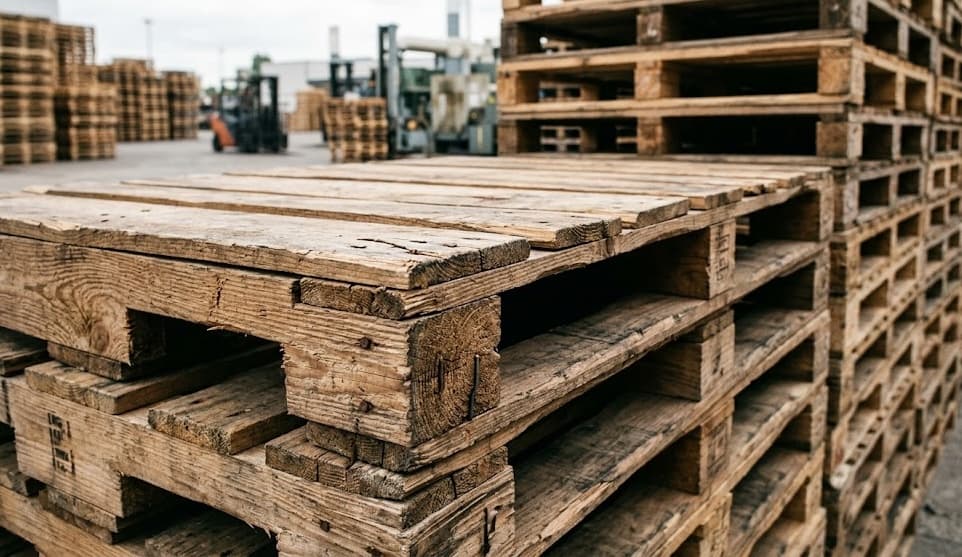
Expert craftsmanship that restores damaged pallets to full working condition.
Why Repair Instead of Replace?
Repairing pallets is smarter for your budget and better for the environment. Here is what you gain by choosing refurbishment over replacement.
40-60%
Cost Savings vs. New Pallets
3-5x
Extended Pallet Lifespan
24-48hr
Typical Turnaround Time
70%
Less Carbon Than Manufacturing New
Types of Damage We Repair
No matter how your pallets were damaged, our team has the skills and materials to restore them. Here are the most common issues we handle daily.
Broken Deck Boards
Cracked, split, or snapped top and bottom boards are the most common pallet damage. We replace individual boards with matching lumber, restoring full load capacity.
Damaged Stringers & Blocks
Stringers and blocks bear the weight of the entire load. When they crack or split, we reinforce or replace them with fresh structural lumber to maintain safety standards.
Loose or Missing Nails
Protruding, bent, or missing fasteners are a safety hazard. We pull damaged nails, reset loose ones, and drive new fasteners to ensure a secure, worker-safe pallet.
Warped or Bowed Boards
Moisture exposure can warp deck boards, causing instability. We replace warped lumber and use kiln-dried or seasoned wood to prevent future warping.
Notch & Fork Damage
Repeated forklift handling gouges out notch openings over time. We rebuild notch areas and reinforce them for extended forklift compatibility and smooth entry.
Water & Weather Damage
Pallets left outdoors suffer rot, mold, and surface degradation. We remove compromised wood, replace it with treated lumber, and restore structural integrity.
Our Repair Process
Every pallet goes through a structured repair workflow designed for speed, quality, and consistency. Here is what happens from the moment your pallets arrive to the moment they ship back.
01
Intake & Sorting
Pallets arrive at our facility and are sorted by condition: minor repair, major repair, or recycle. This triage step ensures each pallet gets the right level of attention.
02
Damage Assessment
Trained inspectors evaluate each pallet, documenting all damage points. We assess structural integrity, board condition, fastener status, and overall safety.
03
Board Replacement & Reinforcement
Broken, missing, or weakened boards are replaced with matching lumber. Stringers and blocks are reinforced or swapped as needed. All new lumber is sourced from our recycling program.
04
Fastener Restoration
All nails are checked. Loose fasteners are reset, damaged ones removed, and new nails driven according to industry specifications. No protruding nails leave our shop.
05
Quality Inspection
Each repaired pallet passes a multi-point quality check: load capacity, dimensional accuracy, board tightness, nail depth, and overall structural soundness.
06
Grading & Delivery
Repaired pallets are graded (A, B, or C) based on final condition and cosmetic appearance. They are then stacked, staged, and prepared for pickup or delivery.
Quality Standards
Built to the Same Standard as New
A repaired pallet from Albuquerque Pallets is not a compromise. Our quality standards ensure that refurbished pallets meet or exceed the performance requirements for their designated grade. Every pallet passes inspection before leaving our facility.
Our Inspection Checklist
- Load capacity verified -- dynamic and static weight ratings confirmed
- Dimensional accuracy within 1/4 inch of original specifications
- All boards flush and firmly seated with no movement
- No protruding nails, splinters, or sharp edges
- Stringers and blocks structurally sound with no cracks
- Fork entry openings clean and properly dimensioned
- No mold, rot, or insect damage on any component
- Heat treatment re-stamped if required for ISPM-15 compliance
Turnaround Times
1 -- 50 palletsSame day or next business day
51 -- 200 pallets1 -- 2 business days
201 -- 500 pallets2 -- 3 business days
500+ pallets3 -- 5 business days
Rush orders (any qty)Same day (surcharge applies)
Pallet Grading After Repair
All repaired pallets are re-graded based on their final condition. Understanding grades helps you choose the right option for your use case.
View Our Grading GuideHow Much Can You Save?
The math is straightforward. Here is a real-world example of what pallet repair saves compared to buying new.
Sample: 500 Pallets Per Month
Buying new (48x40 standard)500 x $12 = $6,000/mo
Average cost for new standard pallets including delivery.
Repairing existing pallets500 x $5 = $2,500/mo
Average repair cost including pickup, repair, and return delivery.
Monthly savings$3,500/mo
Annual savings: $42,000
Why Repair Costs Less
A typical pallet repair involves replacing 1-3 damaged boards and resetting or replacing a handful of nails. The lumber we use comes from our own recycling program, so material costs are significantly lower than virgin timber. Our repair technicians work efficiently on specialized stations, keeping labor costs per pallet well below what a new build requires.
Most repaired pallets can go through 3-5 additional use cycles before they need attention again. When a pallet finally reaches the end of its structural life, it enters our recycling program -- where the lumber is recovered and used to repair other pallets. It is a closed loop that keeps costs low and waste at zero.
Our Repair Warranty
- 90-day structural warranty on all repaired pallets
- Free re-repair if any component fails under normal use within warranty period
- Replacement at no charge if a repaired pallet cannot be restored to grade standard
- Extended warranty options available for high-value or specialty applications
- Warranty applies to all grades: A, B, and C
Repair FAQ
Is there a minimum number of pallets for repair service?
No minimum. We repair single pallets or thousands. Under 20 is usually best as drop-off; 20+ qualifies for pickup and delivery.
Can you repair pallets that are not standard 48x40 size?
Yes. We repair all sizes and configurations, including block, stringer, and custom dimensions with matched lumber.
How do you determine if a pallet should be repaired or recycled?
If over half the boards need replacement or stringers are severely damaged, recycling is more economical. We recommend the lowest-cost option.
Do you pick up damaged pallets from my location?
We offer pickup across the Albuquerque metro and beyond, with scheduled routes for recurring repair customers.
What happens to the damaged boards you replace?
Removed boards enter our recycling stream: usable sections become repair stock; the rest becomes mulch, animal bedding, or biomass fuel.
Cost Analysis
Repair vs. Replace: Cost Comparison
Every scenario is different. Here are real-world cost comparisons for common pallet damage situations to help you decide.
| Damage Scenario | Repair Cost | Replace Cost | Savings | Recommendation |
|---|---|---|---|---|
| 1-2 broken deck boards | $3-$5 | $8-$14 (used) / $12-$25 (new) | 60-80% | Always repair |
| 3-4 broken deck boards | $5-$8 | $8-$14 / $12-$25 | 40-65% | Repair recommended |
| Cracked stringer (partial) | $4-$7 | $8-$14 / $12-$25 | 50-70% | Repair with reinforcement |
| Broken stringer (full crack) | $6-$10 | $8-$14 / $12-$25 | 25-55% | Repair if block area intact |
| Multiple loose/missing nails | $2-$4 | $8-$14 / $12-$25 | 70-85% | Always repair |
| Warped boards (2-3 boards) | $4-$7 | $8-$14 / $12-$25 | 45-65% | Repair recommended |
| Fork entry damage | $5-$9 | $8-$14 / $12-$25 | 35-55% | Repair if notch area rebuildable |
| 50%+ boards need replacement | $8-$12 | $8-$14 / $12-$25 | 0-30% | Replace usually more economical |
All repair costs include labor, materials, and quality inspection. Prices are per pallet for standard 48x40 GMA pallets. Custom sizes and specialty pallets may vary. Contact us for a free assessment of your specific pallets.
Damage Encyclopedia
Common Damage Types & Solutions
Our technicians handle every type of pallet damage imaginable. Here are the most common issues with their causes and how we fix them.
Split Deck Boards
Cause:
Overloading, forklift impact, or nail placement too close to board edge
Our Solution:
Remove and replace with matching-dimension board. Re-nail with spiral nails positioned 1" from edges.
Prevention:
Avoid exceeding rated load capacity. Use anti-slip pads to distribute weight evenly.
Cracked Lead Boards
Cause:
Forklift forks striking the leading edge during entry. Most common pallet damage type.
Our Solution:
Replace lead board with hardwood upgrade for increased impact resistance. Chamfer leading edge.
Prevention:
Train forklift operators on proper entry technique. Use pallets with chamfered stringers.
Broken Center Stringer
Cause:
Racking with center span unsupported, or static overload exceeding racking capacity
Our Solution:
Sister a reinforcement board alongside the cracked stringer, or full stringer replacement if crack is catastrophic.
Prevention:
Verify racking load ratings. Do not rack pallets beyond their rated racking capacity.
Protruding Nails
Cause:
Wood shrinkage from moisture loss, vibration during transit, or substandard initial nail depth
Our Solution:
Pull protruding nails, reset or replace with ring-shank nails driven to proper depth below wood surface.
Prevention:
Use ring-shank or spiral nails that resist withdrawal. Ensure proper nail gun depth settings.
Mold & Mildew Growth
Cause:
Prolonged exposure to moisture without airflow. Common in outdoor storage and humid warehouses.
Our Solution:
Remove affected boards, treat remaining structure with anti-fungal solution, replace boards with KD lumber.
Prevention:
Store pallets off the ground on concrete. Ensure warehouse ventilation. Use KD lumber in humid environments.
Delaminated Block Joints
Cause:
Repeated dynamic loading causes glued block-to-deck connections to separate
Our Solution:
Reattach blocks with combination of construction adhesive and through-nailing with ring-shank nails.
Prevention:
Specify mechanical fastening in addition to adhesive on custom builds for dynamic applications.
Notch Erosion
Cause:
Hundreds of forklift entries gradually wear away the notch opening material
Our Solution:
Rebuild notch area with hardwood insert and reinforcement plate. Restores smooth fork entry.
Prevention:
Rotate pallets through different dock positions. Use hardwood stringers on high-cycle pallets.
Insect Infestation
Cause:
Untreated or expired HT pallets stored outdoors in warm climates attract wood-boring beetles and termites
Our Solution:
Remove and destroy infested boards. Re-heat-treat entire pallet to eliminate larvae. Replace damaged components.
Prevention:
Use only HT-stamped pallets. Re-treat pallets that have been repaired with untreated wood before storage.
Quality Standards
Quality Assurance Process
Every repaired pallet passes through a rigorous 12-point quality assurance checklist before it leaves our facility. Here is the detailed breakdown.
01
Dimensional Verification
Length, width, and height measured against original specification. Tolerance: within 1/4 inch on all dimensions.
02
Board Tightness Test
Every board is physically tested for movement. No board should shift, rock, or lift when force is applied.
03
Nail Depth Inspection
All fastener heads must be flush with or slightly below the wood surface. Zero protruding nails permitted.
04
Stringer Integrity Check
Stringers are inspected for cracks, splits, and reinforcement quality. Load-bearing capacity verified per grade.
05
Fork Entry Clearance
Fork openings measured for smooth entry and exit. Minimum 3.5 inch clearance for standard fork tines.
06
Surface Hazard Scan
Entire pallet surface checked for splinters, sharp edges, protruding staples, and any worker-safety hazards.
07
Moisture Content Spot Check
Random boards tested with pin moisture meter. Acceptable range: 12-25% for domestic use, under 19% for HT compliance.
08
Contamination Screening
Visual and olfactory check for chemical stains, oil residue, mold, and pest evidence on all repaired surfaces.
09
Weight Capacity Validation
Repaired pallet grade assigned based on estimated remaining load capacity. Grade stamp applied.
10
HT Compliance Verification
If ISPM-15 required, verify heat treatment stamp integrity. Re-stamp if obscured by repair work.
11
Cosmetic Grade Assessment
Final cosmetic evaluation determines grade (A, B, or C) based on appearance, wear, and repair visibility.
12
Documentation & Tracking
Repair details logged in our tracking system: date, technician, repairs performed, grade assigned, and customer.
Repair Is Recycling in Action
Every pallet we repair is one that does not need to be manufactured from scratch. That means fewer trees harvested, less energy consumed, and lower carbon emissions. On average, repairing a pallet uses 70% less energy than building a new one. Multiply that across thousands of pallets and the environmental savings are enormous.